Cookbook Challenge #5 - Ruhlman’s Twenty
In this week’s episode, Susanna makes mistakes, deals with missing ingredients, and kinda burns both things she cooks…but it tastes pretty good anyway.
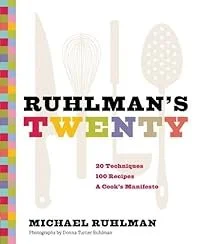
When I skimmed through Ruhlman’s Twenty by Michael Ruhlman (2011), it ended up peppered with post-it flags for recipes I’d like to try. It’s in the “real chef educating home cooks” genre, with each of the twenty chapters focused on a key ingredient family or technique. I ultimately chose Snickerdoodles from the Dough chapter and Weekday Coq au Vin from the Water chapter, but I left the other flags in place for possible future delectation.
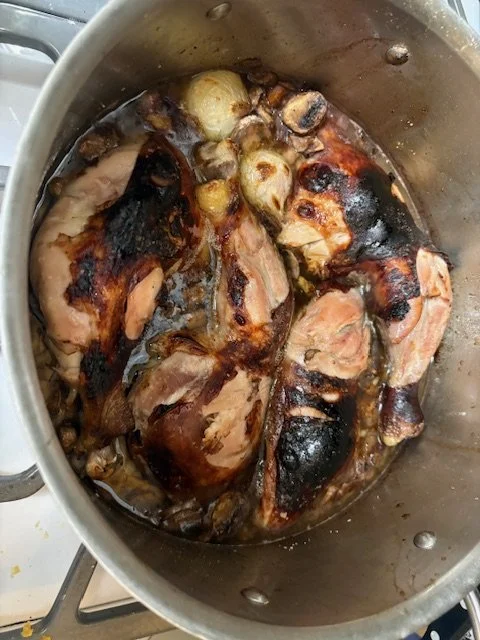
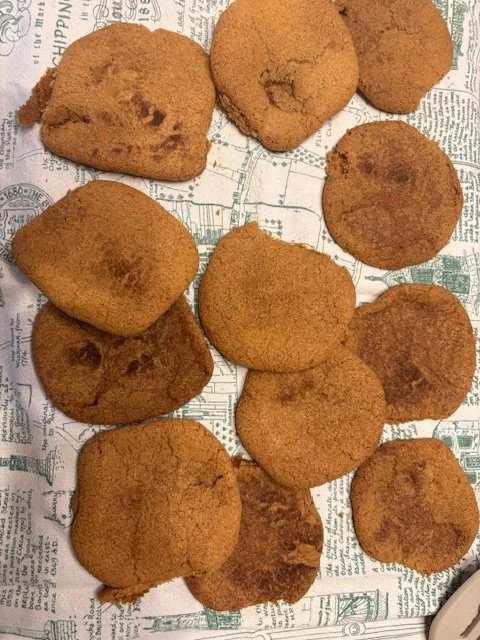
As the pictures illustrate very well, neither of my attempts yielded a perfect, photogenic result. I burned the snickerdoodles a bit because the cookies didn’t look cooked through to me when the edges were golden, so I went by the 15 minute cooking time. Also, I completely by accident doubled the butter, because between setting out the butter to come to room temperature and actually using it, I forgot that I was only supposed to use half the stick. However, the recipe notes DO list doubling the butter as an option if you prefer thin cookies, which I do, so it’s all good. They were straight-up delicious, though they ended up strangely hollow in the middle, sort of like a macaron. I don’t know if that was the extra butter, the fact I should’ve pulled them a minute or two earlier, or a feature of the fact the sugar-to-flour ratio is 2:1.
The coq au vin ended up missing the listed carrot. I bought a single carrot on my Saturday grocery run (since none of my other meal plans for the week involve them), and I distinctly remember both selecting a good-sized one and watching the checker ring it up, because it’s not often you buy anything for only $0.30 these days. But when I looked for it in the fridge last night it was nowhere to be found, and my husband and son (who unpacked the bags) didn’t remember seeing it, so the bagger must’ve missed it.
Of course, that’s not the reason it looks so ugly in the image—that’s because I didn’t pull it out of the oven when I should’ve because I was draining the noodles I served it over, and, as I should know by now, the broiler can take food from crispy to blackened while your back is turned. It still tasted good, though. I’ll probably make it again, but maybe use thighs and drumsticks rather than whole leg quarters, and reduce the initial roasting time accordingly.
Snickerdoodles
1/4 c/55 g butter, at room temperature
1/2 c/100 g firmly packed brown sugar
1.5 c/300 g granulated sugar
1 large egg
1 c/140 g all-purpose flour
1 tsp baking power
kosher salt
Cinnamon sugar
1/4 c/50 g granulated sugar
4 tsp ground cinnamon
Preheat the oven to 350 F. In a large bowl, combine the butter and sugars. Using a stiff spatula, stir and paddle the ingredients until uniformly combined. Add the egg and whisk rapidly until it is combined into the butter mixture.
In a small bowl, combine the flour, the baking powder, and a three-finger pinch of salt. Stir to distribute the baking power. Fold the flour mixture, in a few batches, into the butter mixture until completely incorporated.
Scoop out tablespoons of the dough and arrange them about three inches apart on a baking sheet/tray. Cover the top of a glass with a damp towel. Press the covered opening of the glass down onto each cookie.
Make the cinnamon sugar: In a small bowl, stir together the granulated sugar and cinnamon until the cinnamon is uniformly distributed.
Sprinkle the cookies with the cinnamon sugar (save leftovers for cinnamon toast!). Bake until the cookies are cooked through and the edges are golden, about 15 minutes.
Weekday Coq au Vin
4 chicken legs
4 oz bacon strips, cut into 1/2-inch pieces
1 medium onion, finely diced
4 garlic cloves, smashed with the flat side of a knife
kosher salt
3 T all-purpose flour
1 carrot (AWOL)
8 shallots, peeled
2 bay leaves
1/2 lb white mushrooms, quartered (I accidentally bought sliced)
1.5 c red wine (I used a mid-shelf Washington merlot that was on sale because I’m trying to be frugal but it seemed like blasphemy against France to use super-cheap stuff)
2 T honey
freshly ground black pepper
Preheat the oven to 425 F. Place the chicken legs on a large baking sheet/tray and roast for 20 minutes. Remove from the oven and reduce oven temperature to 325 F.
While the chicken is roasting, put the bacon, onion, and garlic in a large ovenproof frying pan, Dutch oven, or other heavy ovenproof pot. The cooking vessel should be large enough to hold the chicken legs snugly in one layer. Add two three-finger pinches of salt and enough water just to cover the ingredients. Cook over high heat until the water has cooked off, about 5 minutes. (My stovetop took at least 10, dang it.) Reduce the heat to medium-low and cook, stirring, until the onion has begun to caramelize, about 5 minutes more. Sprinkle the flour over the onion and bacon and stir to distribute it.
Nestle the chicken skin-side down into the onion mixture in one layer. Tuck the carrot into the pan (alas for my $0.30 carrot!), followed by the shallots and bay leaves, and then the mushrooms. Add the wine and honey and season with pepper. Add enough water to reach 3/4 of the way up the chicken. Bring to a full simmer over high heat. Slide the pan, uncovered, into the oven.
Cook the chicken for 20 minutes. Remove the pan from the oven, turn the chicken skin-side up, and stir the ingredients to make sure that they cook evenly. Taste the sauce; add salt if it needs more. Continue to cook until the chicken is tender, about 20 minutes longer. Remove the pan from the oven. Just the skin side of the chicken should be above the liquid. Set the oven to broil. Broil until the skin is crisp, 3-4 minutes. Remove and discard the carrot and bay leaves.