Cookbook Challenge # 13 - More With Less
More With Less (1976) is a recipe collection published by the Mennonite Central Committee that was very popular among my decidedly non-Mennonite post-collegiate social circle in the early 1990s, largely I think for the somewhat lefty faith-based frugality of it all. It has a few favorite recipes I go back to regularly, notably the Old-Fashioned Bread Omelet, which is a perfect quick, filling meal when you have a few eggs, a little bit of milk and cheese, and the heel end of some good bread, and Kusherie, which is a bit of a production with all the chopping and multiple pots involved but is also how I first experienced the glories of deeply caramelized onions. With that said, it’s very much of its era, and the recipes run to the hearty and bland.
Tonight our dinner was Hearty Lentil-Sausage Soup, which was indeed hearty and on the bland side. Though in fairness, the recipe contributor (Mabel Eshleman of Lancaster, PA) did recommend having Tabasco sauce ready to pass at the table.
Hearty Lentil-Sausage Soup
Brown in 5 qt kettle:
1 lb pork sausage, broken into chunks
Remove meat and pour off all but ¼ c drippings. (Modern sausage and pork in general being leaner than that of 50 years ago, there wasn’t even that much fat left in total.) Add:
2 medium onions, chopped
1 garlic clove, minced
4 medium parsnips, cut in chunks (optional)
Cook five minutes until onions and garlic are tender. Add:
2 c lentils
1 T salt
½ tsp marjoram (I used a full tsp of Italian seasoning since it’s mostly marjoram, and the only marjoram-only spices at my local QFC were ridiculously expensive for an herb I rarely use)
2 c cooked tomatoes or juice (I used a 14 oz can diced plus a small can of tomato paste)
2 qt water
browned sausage
Simmer 30 minutes or until tender. (At 30 minutes the lentils were al dente and the parsnips not quite done, so I let it go another 15.) Cut in diagonal slices:
1 loaf Italian bread
To serve, place a bread slice in each soup bowl and spoon soup over bread. (I had a loaf of take-and-bake garlic bread on the shelf, so I heated that up and served it alongside instead.)
Cookbook Challenge # 12 - Grist
Grist: A Practical Guide to Cooking Grains, Beans, Seeds, and Legumes by Abra Berens (2021) is what it says on the tin—an encyclopedic guide to working with both the well-known and more obscure members of those culinary families. As part of our Easter dinner, I made Cranberry Bean Salad w/ Roasted Carrots, which also entailed making one of the condiments from the front of the cookbook, Mojo de Ajo. It all came out pretty good, and certainly paired nicely with the ham. I’m not sure I’ll make the beans or mojo de ajo again, but I for sure will add those roasted carrots to my repertoire as a simple, spicy-sweet way to make use of an accessible, affordable vegetable.
Cranberry Bean Salad w/ Roasted Carrots
1 lb dried cranberry beans
1 onion, cut into chunks
10 sprigs thyme, tied in a bundle
3 bay leaves
1 tsp salt, plus more for the carrots
1 lb carrots, cut in half
olive oil
chili flakes
1 recipe Mojo de Ajo
10 sprigs cilantro, stems and leaves roughly chopped
½ cup pepitas, toasted
In a large pot, cover the beans with water by 2 inches. Add the onion, thyme, and bay leaves. Bring to boil, then turn down to a simmer and cook until the beans are tender (anywhere from 20 to 90 minutes, depending on whether the beans have been soaked and their freshness). When the beans are tender, add the salt and let sit for 10 minutes. Remove the herbs and discard.
Preheat the oven to 400 F. Toss the carrots with a glug of olive oil, a couple pinches of salt, and a pinch of chili flakes. Roast the carrots until deeply caramelized on the outside and tender on the inside, about 40 minutes.
To serve, spoon a heaping serving of cooked beans per person into a bowl and gently fold in ¼ cup of mojo de ajo per serving. Transfer the beans into a serving dish or individual bowls, portion the carrots evenly among the serving dishes, and garnish with the chopped cilantro and a handful of pepitas.
Mojo de Ajo
1 cup neutral oil
20 garlic cloves, peeled and left whole
2 sprigs oregano
3 limes, zest and juice
1 orange, zest and juice
Preheat the oven to 300 F. Combine the oil, garlic cloves, and oregano in a small ovenproof pot. Bake for 45 minutes or until the garlic is soft and fragrant.
Allow to cool. Remove the oregano sprigs, squeezing any oil clinging to the leaves back into the pot. Add the citrus zest and juice and a couple of pinches of salt. Stir to combine, lightly smashing the garlic clvoes with the back of the spoon to make a thick, oily sauce.
March reading
The Nebula finalist list came out this month, so as predicted I picked up my reading pace, finishing a total of 16 books. (OK, some were novellas or novelettes, but that’s still a lot of reading.) Overall, this was a great reading month, before and after diving into the Nebula list.
Imposter Syndrome and Other Confessions of Alejandra Kim by Patricia Park. A YA coming-of-age story about a high school senior who, as a scholarship student at a prep school and the ethnically Korean daughter of immigrants who came to America from Argentina doesn't feel like she really fits in anywhere.
There Will Be Fire by Rory Carroll. I was 13 when the IRA bombing/attempted assassination of Margaret Thatcher happened, so I must've heard about it at the time--my family watched the NBC Nightly News religiously--but it didn't make enough of an impression on me that I remembered it. Carroll managed to make me feel empathy will all sides, which is remarkable, given that I'm not prone to compassion for terrorists or, for entirely different reasons and on a different level, Thatcherite Tories.
Ruby Finley vs. the Interstellar Invasion by K. Tempest Bradford. Just a charming middle grade novel about a sixth grade aspiring entomologist who finds a strange bug that's maybe not of this world...
The Voyage of the Beagle by Charles Darwin. Basically an 1830s travelogue by an uncommonly smart, observant, and probably some flavor of neurospicy young man who readers know will later go on to develop the theory of evolution. He's already very much the scientist, though from his observations on geology and geography I'm almost surprised he didn't stumble upon plate tectonics, and he also flirts with germ theory on occasion.
The Wind's Twelve Quarters by Ursula K. Le Guin. I expected to like this better than I did, since Le Guin was an acknowledged master of a genre of fiction that forms the majority of my fiction reading and all of my current writing. But most of the stories in this collection left me a bit cold--they just left me feeling distant, like an observer rather than a sort of vicarious participant. "The Ones Who Walk Away From Omelas" deserves every bit of its reputation as a classic, though.
Nobody's Baby by Olivia Waite. Second in a series of cozy and delightful space mysteries set aboard a generation ship. (Full disclosure: the author is a friend of mine.)
Challenger: A True Story of Heroism and Disaster on the Edge of Space by Adam Higginbotham. I thought I knew almost everything there was to know about what led to the Challenger's destruction. We even studied the Morton Thiokol engineers' attempt to get the launch canceled as a Harvard Business School case study in a business ethics class my senior year in college! But this book shows just how deep the technological and especially cultural/management problems were, and of how long a duration. I finished the book amazed that NASA has only lost three crews...but also with just a hint of nostalgia for the child I once was, watching shuttle launches in school, visiting the Marshall Space Flight Center on field trips, and dreaming of maybe becoming an astronaut.
A Radical Act of Free Magic by H.G. Parry. I absolutely adored this book (the second in an alternate history duology that began with A Declaration of the Rights of Magicians), partly for its theme of fighting on in the face of apparent hopelessness, but mostly for the characters and their bonds with each other, particularly the friendship between Williams Pitt and Wilberforce that's the beating heart of the story.
Blessings and Disasters by Alexis Okeowo. Memoir/history/current events journalism by an author who grew up in my own home state of Alabama, though she's a bit over 10 years younger than me and grew up in Montgomery as the child of Nigerian immigrants while I grew up in a rural area not far from Birmingham as a child of mostly Scots-Irish descent whose family showed up around 1820. It's a good book, and I found truth in how she describes Alabamians as simultaneously and genuinely both kind and generous and cutthroat and ruthless.
A Bride's Story, Volume 15 by Kaoru Mori. Latest in this gorgeously illustrated historical manga series.
Sunrise on the Reaping by Suzanne Collins. I begin my marathon of 2025 Nebula finalist reading with this finalist for the Andre Norton Nebula Award for Middle Grade and Young Adult Fiction. Collins is an excellent writer, and this book would've kept me turning the pages even if I weren't embarking upon a speed-reading marathon, but I hated the fact that I knew everything was going to end so horribly given that this is the story of Haymitch Abernathy's Hunger Games. Sort of like watching Rogue One that way.
Never Eaten Vegetables by H.H. Pak. Book two in the Nebula marathon is a novelette about a colony ship carrying embryos and one of the embryos in question as a young woman of 26. It took me a few pages to get into the rhythm of the alternating timelines, but I found this quite lovely and moving.
Sour Cherry by Natalia Theodoridou. Nebula reading continues with this Best Novel nominee. This is a gothic horror retelling of the Bluebeard story. I can tell it's excellently done, creepy and disturbing, but I'm not as much of a horror fan as I am science fiction and fantasy, particularly with books like this one which are unrelentingly bleak.
The River Has Roots by Amal El-Mohtar. This Nebula Novella finalist was just...chef's kiss...for me. Beautiful writing, satisfying story.
Uncertain Sons by Thomas Ha. Nebula finalist, Novelette category. This one felt old-school to me, and I don't mean that in a bad OR a good way. It just had the feeling of a horror-infused SF adventure that I wouldn't have been surprised to find in, say, a collection of top-quality SF from 1985 instead of among 2025 award finalists.
Wearing the Lion by John Wiswell. Nebula finalist, Novel category. This one is a sheer delight from beginning to end, humor and heart balancing genuine grief and a touch of horror in a tale alternating between the POVs of a sweet-natured himbo Heracles and a Hera showing divine excess in both vengeance and repentance.
Cookbook Challenge # 11 - EveryDayCook
EveryDayCook by Alton Brown (2016) is the second Alton Brown cookbook I’ve drawn, this one focused more on how he cooks at home than his Good Eats repertoire. Out of many good choices, I settled on Breakfast Carbonara (though I served it for dinner) and Hot Saltine Hack. I’ll probably add the carbonara to my regular rotation, and I thought the saltines were interesting. I might try them again some other time with a different flavor than mustard. Chili powder or cumin might be nice, or you could take them in a sweet direction with a lighter hand on the hot sauce and a bit of cinnamon and sugar.
Breakfast Carbonara
1 T grated orange zest
¼ cup fresh flat-leaf parsley, finely chopped
¼ cup fresh bread crumbs (I used panko)
1 T kosher salt
8 oz dry linguine, regular or whole wheat
8 oz bulk breakfast sausage
2 scallions, thinly sliced
4 large eggs, at room temperature
3 oz finely grated Pecorino Romano (I used parmesan because I couldn’t find pecorino romano at the store)
1 tsp freshly ground black pepper
Combine the orange zest, parsley, and bread crumbs in a small bowl. Set aside.
Add two quarts water, the salt, and linguine to a large saute pan. Cover and bring to a boil over medium-high heat. Reduce the heat to low and cook for 4 minutes, or until the pasta is al dente. (I just used my regular pasta into a large pot of boiling salted water technique. I know it’s starting to sound like I’ve substituted ingredients and technique to excess, but I swear it came out a lot like the picture in the cookbook, and I think I stayed true to the spirit of the dish.)
Meanwhile cook the sausage in a 12-inch cast iron skillet over medium-high heat until brown. Add the scallions and cook until fragrant.
While the pasta and sausage are cooking, whisk together the eggs, cheese, and pepper.
Drain the pasta, reserving ¼ cup of the pasta water. Add the pasta to the sausage, tossing the pasta to coat in the fat. (I threw in a splash of olive oil because the sausage was super lean.)
Remove from the heat, add the egg mixture, and thin as needed with the reserved pasta water.
Serve immediately with a generous sprinkle of the pasta mixture.
Hot Saltine Hack
2 T clarified butter, melted
1 T hot sauce
1 tsp dry mustard powder
1 sleeve saltines (about 40 crackers)
Heat the oven to 350 F.
Meanwhile, whisk the butter, hot sauce, and dry mustard together in a large mixing bowl. Add the saltines and toss to coat.
Spread the crackers on a half sheet pan.
Bake for 8 to 10 minutes, until the saltines just start to brown.
Brown suggests serving these with a sardine pate recipe from the book, but I’m not a sardine person, nor indeed a fish person in general. They’d probably be good with any number of pates or creamy savory spreads, though.
Cookbook Challenge # 10 - What’s For Dessert
After skipping last weekend because I had a back pain flare, I’m back to my cookbooks this week. This afternoon I baked the Crunchy Almond Cake from What’s For Dessert by Claire Saffitz (2022). It bills itself as featuring simple recipes, but I’d say its idea of simple is something like the AllTrails ranking of hike difficulty, where you embark upon what claims to be an easy hike and find yourself scrambling over boulders alongside a mini-ravine in an obscure North Georgia state park and wondering how long it’ll take anyone to find you if you fall and break your leg or worse, not that I’m speaking from very specific personal experience or anything. (Luckily the only thing that fell was my level of trust in the AllTrails app.)
With that said, I’m a far more experienced cook and baker than I am a hiker, so this cake was well within my competency level, but this is not the cookbook for a beginner. My chosen recipe rated as Very Easy, which is the lowest ranking in the book, but as you’ll see it’s fairly time-consuming and fiddly. It’s delicious, though, and would make an AMAZING based for strawberry shortcake or with a rich chocolate sauce. And I’m sure I’d find it quicker and simpler on a second or third attempt.
Crunchy Almond Cake
1 cup sliced unblanched almonds
Melted butter for the pan
¼ cup demerara sugar (I used turbinado, which isn’t quite the same but is what I could readily source)
¾ cup plus 2 T all-purpose flour
1 tsp baking powder
¾ tsp Diamond Crystal kosher salt or ½ tsp Morton kosher salt
7 oz almond paste
1 ½ sticks unsalted butter at room temperature
2/3 cup granulated sugar
4 large eggs at room temperature
¼ cup amaretto
2 tsp vanilla extract
Preheat the oven: Arrange an oven rack in the center position and preheat to 350 F.
Toast the almonds: Scatter the sliced almonds across a sheet pan in an even layer and toast until they’re golden and fragrant, 5 to 8 minutes, tossing halfway through. Set aside to cool. Leave the oven on.
Prepare the pan: Brush the bottom and sides of a 9-inch cake pan with melted butter, then line the bottom with a round of parchment paper and smooth it to eliminate any air bubbles. Butter the parchment.
Make the crunchy layer: Lightly sprinkle some of the demerara sugar across the bottom of the prepared pan, then scatter a handful of the toasted almonds on top (it’s fine if they’re still warm). Sprinkle with more demerara sugar, scatter more almonds, and continue alternating until you’ve used all the demerara sugar and toasted almonds and covered the bottom of the pan in an even layer. Set the pan aside.
Mix the dry ingredients: In a medium bowl, whisk together the flour, baking powder, and salt until combined. Set aside.
Cream the almond paste, butter, and sugar: Crumble the almond pasted into a large bowl (your standard mixing bowl if you’re using a stand mixer) and break up any larger pieces with your fingertips. Add the butter and granulated sugar and beat with a hand mixer or stand mixer with the paddle attachment at medium-low speed until the sugar and butter are incorporated. Increase the speed to medium-high and beat, pausing occasionally to scrape down the sides of the bowl, until the almond paste is broken down into tiny pieces and the mixture is pale and fluffy, about 5 minutes.
Beat in the eggs: Beat the eggs one at a time on medium-high until smooth, then continue to beat until the mixture is very light, thick, and creamy, about 1 minute longer.
Make the batter: Reduce the mixer speed to low and add about half of the dry ingredients, mixing just until the flour disappears, then add the amaretto and vanilla and mix until combined. Add the remaining dry ingredients and mix just until you have a smooth batter. Switch to a flexible spatula and fold the batter several times, scraping the bottom and sides of the bowl, to make sure it’s evenly mixed.
Fill the pan: Slowly and gently scrape the batter into the prepared pan, trying not to disturb the almonds and sugar at the bottom. Carefully work the batter to the edges of the pan with a spatula and smooth the surface.
Bake: Bake the cake until the surface is domed and deep golden brown (it will brown more than you might expect) and a toothpick or cake tester inserted into the center comes out clean, 35 to 40 minutes (mine took closer to 45). Let the cake cool in the pan for 15 minutes, then, using a small offset spatula or paring knife and keeping it pressed firmly against the side of the pan, cut down and around the cake to loosen it. Invert the cake onto a wire rack and slowly remove the pan, then carefully peel away the parchment if it sticks to the cake. Let cool completely.
February Reading
I read 11 books in February, just like January. I’ll need to pick up the pace soon, once the Hugo and Nebula finalist lists come out.
Brigands and Breadknives by Travis Baldree: The latest entry in the Legends & Lattes cozy fantasy-verse, wherein Fern the rattkin bookseller from Bookshops & Bonedust undergoes something of a midlife existential crisis, along with adventures with a legendary elf adventurer, a goblin, and talking blades.
Pathogenesis: A History of the World in Eight Plagues by Jonathan Kennedy: Its subtitle is a misnomer, as it's more a world history focusing on how infectious diseases impacted history across eight different eras than an epidemiological history of the diseases in question. With that said, I think it's an interesting read, but you should know going in not to expect, say, a deep dive into the Great Plague of Athens and its possible causes, and that he barely addresses the medical side of the great 20th and 21st century pandemics (influenza, HIV, Covid), instead focusing on how socioeconomic factors influenced the impact of the latter two in different parts of the world.
Time Loops & Meet Cutes by Jackie Lau: One of my favorite contemporary romance authors dips her toe into SFF with a time loop romance--our heroine gets stuck on June 20 after eating dumplings from a mysterious booth at a night market in Toronto on her way home from work--and it's charming.
Building God’s Kingdom by Julie Ingersoll: This 2015 book is an academic examination of Christian Reconstructionism--a subset of Calvinism that advocates for a form of theocracy (though they don't like it when you call it that). Ingersoll focuses on how a movement that's pretty fringe in terms of adherents who affirmatively follow its precepts is hugely influential within the broader religious right, especially through their focus on Christian homeschooling curricula. And while this was far in the future when Ingersoll wrote this (oh, the good old days), their fingerprints are all over Project 2025.
Breach of Promise by Elisabeth Fairchild: This is one of several traditional Regency romances I discovered in a used bookstore in Sequim, WA during a getaway to the Olympic Peninsula last fall. Books like this were my romance gateway drug as a teen, and I still have a nostalgic love of them. For this particular entry, I enjoyed the section where the hero and heroine were exploring the Cotswold countryside, though I felt like the antagonists were a bit cartoonish, and the hero's noble titles weren't handled quite right--a nitpick of mine since I figured out how they worked and committed the system to memory when I was writing this era and get annoyed when they're wrong. Like, even in a total romp with deliberately anachronistic social mores--which this isn't--IMHO it's best to get those historical and cultural details right. It's not like the people who don't know or care about this stuff will mind them being right, and you'll avoid pulling utter nitpicky pedants like me out of the story.
Lin-Manuel Miranda: The Education of an Artist by Daniel Pollack-Pelzner: I'm as big a Hamilton fan as you'd expect from someone who's really into history and somewhat into musical theater, and I both admire and envy Miranda's talent and the fact he was able to accomplish so much so young. This book did not change any of that, and gave me added insight into all the collaboration and iteration that's gone into making his work so successful. As a writer, my creative work isn't as inherently collaborative, but I could still learn a lot about patience and persistence in editing and rewriting.
The Barren Grounds by David Roberston: This is the first in a middle grade portal fantasy series about a pair of First Nations foster siblings who find a way into a world stuck in an endless winter (somewhat a la Narnia) but populated with animal people from the author's (and the protagonists') Cree heritage. It was a nice Sunday afternoon read for me, though I doubt I'll continue the series--at least for me, it's a very good story for the age group it's written for but didn't have as much crossover appeal for adult readers.
The Barn: The Secret History of a Murder in Mississippi by Wright Thompson: A deep history of Emmett Till's murder that puts the events and people involved into a rich context of the specific place and time that the atrocity unfolded in.
Useless Etymology by Jess Zafarris: After bouncing off the light fiction read I'd intended for a break between two heavy nonfiction histories, I chose this fun, chatty book about etymology instead. Among other things, I now know that pineapple got its English name from its visual resemblance to a pinecone--which used to sometimes be called a pineapple itself, back when "apple" could mean any fruit or fruit-adjacent thing growing on a tree.
American Midnight by Adam Hochschild: This look at the horrifying, repressive, and often violent assault on Americans' civil liberties during and immediately after WWI delves into little-known history, but on another level it's all too recognizable and familiar.
Over My Dead Body: Unearthing the Hidden History of America’s Cemeteries by Greg Melville: A history and travelogue where the author visits 17 American cemeteries--mostly notable ones, but some obscure--as a sort of journey through how our practices and beliefs around death and dying have changed between Jamestown and now.
Cookbook Challenge # 9 - Rachael Ray Express Lane Meals
So, I forgot to take a picture of this meal…and then I realized that I enjoy cooking, and I like keeping a log of this project, but taking the pictures and getting them to sorta-kinda align properly with the post is fiddly and annoying, so I’m not going to do it anymore! It’s not like I’m expecting or even attempting to have this blog series, or this blog in general, to be some kind of a huge money-making promotional deal for me. It’s more of a diary—I exist, I write things, I read things, and I cook things. (And travel, watch birds, try to identify plants, and all sorts of other things I haven’t written about here as yet.)
With that out of the way, this week’s cookbook was Rachael Ray Express Lane Meals (2006). I have one go-to recipe from it already, easily identified by the cooking stains on the pages: Leek-y Chicken and Couscous. And after this week, I have a second one, despite not being a huge Rachael Ray fan in general. Though I guess it makes sense—it’s basic food for everyday people, and despite certain bougie aspirations most days I’m a basic person just trying to get dinner on the table.
My new recipe is Cowboy Spaghetti, which based on the title I was expecting to have a Tex-Mex vibe, but it’s really more of a cheeseburger or sloppy joe with pasta instead of bread for the starch. Entirely in a good way—all three of us cleaned our plates, and the dish made leftovers enough to keep us in lunches for a couple days.
Cowboy Spaghetti
1 lb spaghetti
1 T olive oil
3 slices bacon, chopped
1 lb ground beef
1 medium onion, chopped
3-4 garlic cloves, chopped (I used a generous teaspoon of jarlic)
2 tsp hot sauce
1 T Worcestershire sauce
14 oz can chopped or crushed fire roasted tomatoes
8 oz can tomato sauce
sharp cheddar cheese, grated
4 scallions, trimmed and chopped
salt and pepper
Bring a large pot of water to a boil. Salt the water and add the spaghetti. Cook the pasta to al dente and drain.
Heat a deep skillet over medium-high heat. Add the olive oil and bacon. Brown and crisp the bacon, then remove with a slotted spoon to a paper towel-lined plate. (Note: The recipe never says when to put the bacon pieces back. I added them just before adding the spaghetti to the sauce, but you could also sprinkle them as a garnish like the scallions.) Drain off excess fat from skillet if necessary, leaving just enough to coat the bottom. Add the beef and crumble it as it browns, 3-4 minutes. Add the onions and garlic and stir into the meat. Season the meat with salt and pepper, hot sauces, and Worcestershire. Cook for 5 minutes more, then stir in the tomatoes and tomato sauce.
Add the hot spaghetti to the sauce and combine. Adjust the seasonings and serve in shallow bowls, topped with cheese and scallions.
Cookbook Challenge # 8 - Good Eats 4: The Final Years
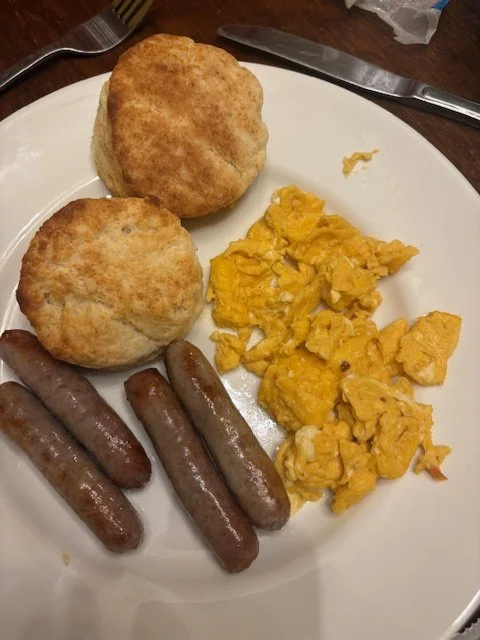
We own all of Alton Brown’s Good Eats cookbooks and several others he authored—it just happened that Good Eats 4: The Final Years (2022) came up first in my random draw. When I saw it included a recipe for buttermilk biscuits, I knew I had to try it. I’ve tried to make homemade biscuits multiple times, all of which were failures that I deemed a dishonor to my Southern heritage. And since I was already set up for breakfast for dinner, I picked scrambled eggs for my second recipe.
Both turned out well. The biscuits weren’t perfect—I think despite my best efforts not to I still overmixed the dough a bit—but they’re definitely the best I’ve ever made. For the eggs, I’m not sure I’ll use the harissa paste again, but I do like the technique of heating the pan in the stove first, since it took all of 30 seconds or so to cook and plate the eggs.
Buttermilk Biscuits: Reloaded
Software
340 g (2 cups + 6 T) all-purpose flour, plus more for dusting
20 g (4 1/2 tsp) baking powder
1/4 tsp baking soda
3/4 tsp kosher salt
60 g (1/4 c) leaf lard, chilled
30 g (2 T) unsalted butter, sliced into 1/8-inch thick pats and chilled
1 c low-fat buttermilk, chilled
Tactical Hardware (i.e. tools you might not have on your shelf already)
A biscuit cutter in the 2 1/2-inch range
Heat the oven to 450 F.
In a large mixing bowl, sift together the flour, baking powder, baking soda, and salt.
Working quickly (so the fats don’t melt) use your fingertips to rub the lard and butter into the dry mixture until it resembles small, coarse chunks—not quite crumbs. (I cheated and used a pastry cutter, since one came with the biscuit cutter set I bought and I remembered that’s how my mom used to do it.)
Make a well in the center and pour in the buttermilk. Stir until the dough just begins to come together. It will be very sticky. While it’s still in the bowl, fold the dough over itself two times so that it takes up any remaining flour, then turn it out onto a lightly floured work surface.
Dust the top of the dough with flour and, with floured hands, gently fold the dough over itself eight more times, turning one quarter turn before each folding motion. Press the dough into a 1-inch thick round, then cut out biscuits with a floured 2 1/2 inch cutter, being sure to press straight down without twisting until the cutter reaches the board. You’ll need to flour the cutter between cuts.
Center the biscuits on a baking sheet, shoulder to shoulder, so that they just touch. Re-form the scrap dough, working it as little as possible, and continue cutting until the dough is used up. You should have about 8 biscuits.
Bake in the center of the oven for 10 minutes. Rotate the pan 180 degrees in the oven and continue baking until the biscuits are tall and light gold on top, 8-12 more minutes depending on your oven and the temperature of the dough.
Remove to a clean kitchen towel set in a bowl and fold the towel over to preserve warmth and steam the biscuits. Serve with butter and jam, or mustard and thin-cut ham, or sausage patties…or just eat them.
A Scary Good Scramble: Reloaded
Software
1 tsp unsalted butter, softened at room temperature for 10 minutes
2 tsp mayonnaise
1 tsp water
1 tsp harissa, optional but highly recommended
1/4 tsp kosher salt
3 large eggs
freshly ground black pepper (optional)
Tactical hardware
A 10-inch carbon-steel skillet
A rubber or silicone spatula
Park the skillet in the middle of the oven and crank the heat to 350 F. When the oven says it has arrived at that thermal destination, let it heat for another 30 minutes.
While the oven and the pan heat, measure the butter out and let sit at room temperature. The butter should be soft but not melted.
When the oven and pan are good and hot, whisk the mayonnaise, water, harissa, and salt together in a medium bowl. Whisk in the eggs one at a time until light and smooth.
Remove the pan from the oven and place over medium heat. Add the butter to the pan and swirl to coat. Pour in the egg mixture and count to 10. Stir twice with a rubber spatula and count to 10 again. Stir two more times and count to 5. Stir 3 final times, making sure any liquid egg makes contact with the pan, and count to 5. Transfer immediately to a plate or platter and serve.
Cookbook Challenge # 7 - Around My French Table
Around My French Table by Dorie Greenspan (2010) is a lovely cookbook I’m sure I’ll revisit in the future, since I was too frazzled and tired to attempt anything particularly challenging from it this weekend. But the Sweet and Spicy Cocktail Nuts I found time to make were tasty indeed, and I’m likely to make them again.
Sweet and Spicy Cocktail Nuts
1/2 c. sugar
1 1/2 tsp salt
1 1/2 tsp chili powder
1/2 tsp ground cinnamon
pinch of cayenne
1 large egg white
2 cups nuts (whole or halves, but not small pieces) - I used pecan halves
Center a rack in the oven and preheat to 300 F. Spray a nonstick baking sheet with cooking spray or line a baking sheet with a silicon baking mat or parchment paper.
Mix the sugar, salt, and spices together in a small bowl. Beat the egg white lightly with a fork in a larger bowl, just breaking up the white so that it’s runny. Toss in the nuts and stir to coat them with the egg white, then add the sugar and spice mixture and continue to stir so that the nuts are evenly coated.
Using your fingers, lift the nuts one by one from the bowl, letting the excess egg white drip back into the bowl. (The drip back part didn’t work for me because the egg white and spice mixture formed a sort of slurry. I think this is why the nuts turned out almost like crunchy pralines, with a thick, crisp meringue coating, but they tasted fine.) Transfer them to the baking sheet, separating them as best you can.
Bake for 30-35 minutes, or until the nuts are browned and the coating is dry. Cook for 5 minutes, then transfer to another baking sheet, a cutting board, or a piece of parchment paper, breaking them apart as necessary, and let cool completely.
Cookbook Challenge #6 - Taste of Persia
This week I cooked from Taste of Persia: A Cook’s travels Through Armenia, Georgia, Iran, and Kurdistan by Naomi Duguid (2016), which is sort of a cookbook/travelogue hybrid, packed with gorgeous photos of food, people, and sights. It would be just as at home on a coffee table as on a cookbook shelf, but the recipes are mostly straightforward and accessible.
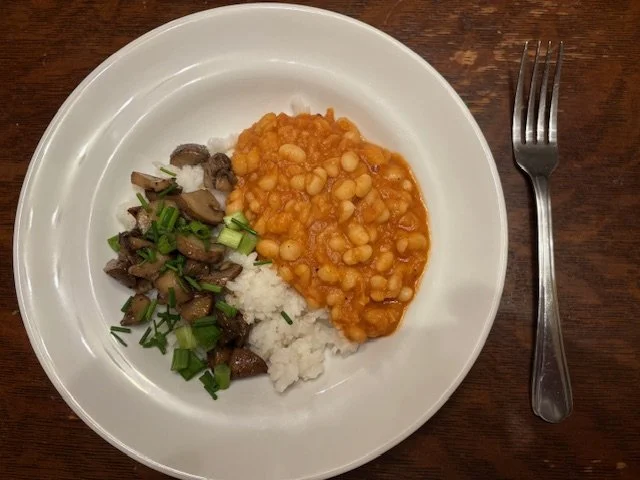
I selected two vegetarian recipes that I could make almost entirely from ingredients already in my pantry: Azeri Mushrooms and Kurdish White Beans. The only things I had to add to my week’s grocery list was fresh mushrooms, scallions, and dill, which makes me feel virtuously frugal.
The results were nothing fancy, but a nice everyday meal with subtly pleasant flavors. I can see myself making the mushrooms again, either as a side dish with meat or, as Duguid suggests in a sidebar, by adding a couple of eggs at the very end of the process for a sort of omelet/scramble.
Azeri Mushrooms
1/2 lb white mushrooms, portobellos, or cremini, cut into bite-size pieces
1 T sunflower or extra virgin olive oil
1/2 c water
1/2 tsp sea salt, or to taste
2 T butter
Generous grinding of black pepper
About 2 T finely chopped fresh dill or scallions (I used both because why not)
Place the mushrooms in a wide heavy skillet or shallow pot over medium heat, add the oil, and shake the pan or stir the mushrooms to spread the oil around. Cook for about a minute, then add the water, raise the heat, and bring the water to a boil. Cover tightly and cook at a strong boil for about 5 minutes. Remove the lid, add the salt, and continue cooking at a medium boil to reduce the liquid. When the bottom of the pain is starting to show, add the butter and stir briefly, then cover and cook over low heat for 5-10 minutes, until the mushrooms are very tender.
Taste for seasoning and adjust if needed. Add the pepper and serve hot or warm, topped with the chopped herbs.
Kurdish White Beans
2 T sunflower or extra virgin olive oil
1/4 tsp turmeric
1 tsp ground cumin
3 cups cooked navy beans with their liquid, or about 2 1/2 cups drained and rinsed canned beans plus 1/2 cup water
1 to 1 1/2 cups water
1/2 cup canned crushed tomatoes
1 dried lime (optional) - I had dried lemons on hand from a previous attempt at a Kurdish stew involving beef and quinces, so I substituted it
1 tsp sea salt, or to taste
Place a heavy pot over medium heat, add the oil, and toss in the turmeric and cumin. Cook for a moment, until you see the turmeric fizzing a little in the oil. Add the beans, the water, and the tomatoes. If using the dried lime, prick it several times with the tip of a knife (be careful not to cut yourself, since it can ricochet if it’s very hard) and add it to the pot. Stir to mix, bring to a boil (press on the dried lime so it takes in liquid and starts to sink, rather than floating on the surface) and boil hard for a few minutes.
Add the salt (only 1/2 tsp if the beans are already seasoned), lower the heat to maintain a strong simmer, partially cover, and cook for 30 minutes. Taste and adjust the seasoning if necessary.
Cookbook Challenge #5 - Ruhlman’s Twenty
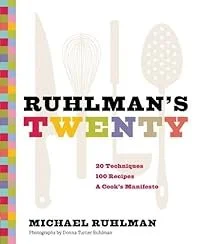
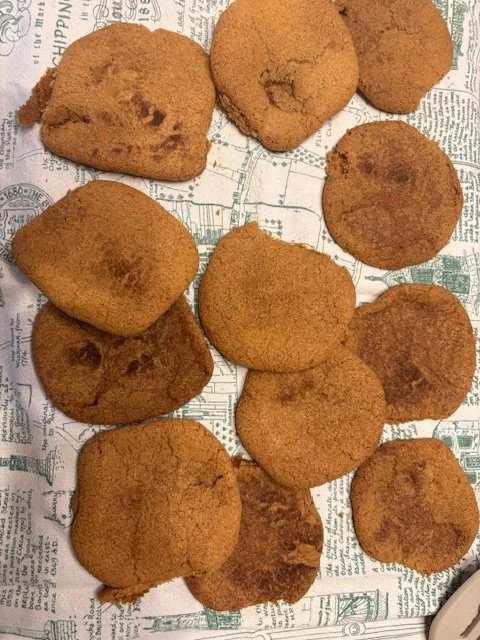
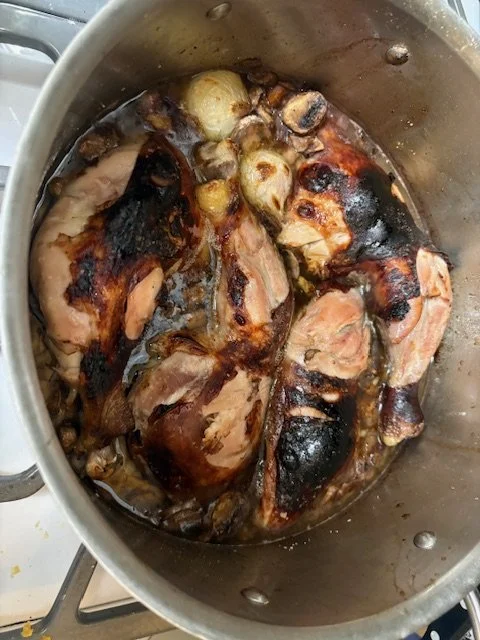
In this week’s episode, Susanna makes mistakes, deals with missing ingredients, and kinda burns both things she cooks…but it tastes pretty good anyway.
When I skimmed through Ruhlman’s Twenty by Michael Ruhlman (2011), it ended up peppered with post-it flags for recipes I’d like to try. It’s in the “real chef educating home cooks” genre, with each of the twenty chapters focused on a key ingredient family or technique. I ultimately chose Snickerdoodles from the Dough chapter and Weekday Coq au Vin from the Water chapter, but I left the other flags in place for possible future delectation.
As the pictures illustrate very well, neither of my attempts yielded a perfect, photogenic result. I burned the snickerdoodles a bit because the cookies didn’t look cooked through to me when the edges were golden, so I went by the 15 minute cooking time. Also, I completely by accident doubled the butter, because between setting out the butter to come to room temperature and actually using it, I forgot that I was only supposed to use half the stick. However, the recipe notes DO list doubling the butter as an option if you prefer thin cookies, which I do, so it’s all good. They were straight-up delicious, though they ended up strangely hollow in the middle, sort of like a macaron. I don’t know if that was the extra butter, the fact I should’ve pulled them a minute or two earlier, or a feature of the fact the sugar-to-flour ratio is 2:1.
The coq au vin ended up missing the listed carrot. I bought a single carrot on my Saturday grocery run (since none of my other meal plans for the week involve them), and I distinctly remember both selecting a good-sized one and watching the checker ring it up, because it’s not often you buy anything for only $0.30 these days. But when I looked for it in the fridge last night it was nowhere to be found, and my husband and son (who unpacked the bags) didn’t remember seeing it, so the bagger must’ve missed it.
Of course, that’s not the reason it looks so ugly in the image—that’s because I didn’t pull it out of the oven when I should’ve because I was draining the noodles I served it over, and, as I should know by now, the broiler can take food from crispy to blackened while your back is turned. It still tasted good, though. I’ll probably make it again, but maybe use thighs and drumsticks rather than whole leg quarters, and reduce the initial roasting time accordingly.
Snickerdoodles
1/4 c/55 g butter, at room temperature
1/2 c/100 g firmly packed brown sugar
1.5 c/300 g granulated sugar
1 large egg
1 c/140 g all-purpose flour
1 tsp baking power
kosher salt
Cinnamon sugar
1/4 c/50 g granulated sugar
4 tsp ground cinnamon
Preheat the oven to 350 F. In a large bowl, combine the butter and sugars. Using a stiff spatula, stir and paddle the ingredients until uniformly combined. Add the egg and whisk rapidly until it is combined into the butter mixture.
In a small bowl, combine the flour, the baking powder, and a three-finger pinch of salt. Stir to distribute the baking power. Fold the flour mixture, in a few batches, into the butter mixture until completely incorporated.
Scoop out tablespoons of the dough and arrange them about three inches apart on a baking sheet/tray. Cover the top of a glass with a damp towel. Press the covered opening of the glass down onto each cookie.
Make the cinnamon sugar: In a small bowl, stir together the granulated sugar and cinnamon until the cinnamon is uniformly distributed.
Sprinkle the cookies with the cinnamon sugar (save leftovers for cinnamon toast!). Bake until the cookies are cooked through and the edges are golden, about 15 minutes.
Weekday Coq au Vin
4 chicken legs
4 oz bacon strips, cut into 1/2-inch pieces
1 medium onion, finely diced
4 garlic cloves, smashed with the flat side of a knife
kosher salt
3 T all-purpose flour
1 carrot (AWOL)
8 shallots, peeled
2 bay leaves
1/2 lb white mushrooms, quartered (I accidentally bought sliced)
1.5 c red wine (I used a mid-shelf Washington merlot that was on sale because I’m trying to be frugal but it seemed like blasphemy against France to use super-cheap stuff)
2 T honey
freshly ground black pepper
Preheat the oven to 425 F. Place the chicken legs on a large baking sheet/tray and roast for 20 minutes. Remove from the oven and reduce oven temperature to 325 F.
While the chicken is roasting, put the bacon, onion, and garlic in a large ovenproof frying pan, Dutch oven, or other heavy ovenproof pot. The cooking vessel should be large enough to hold the chicken legs snugly in one layer. Add two three-finger pinches of salt and enough water just to cover the ingredients. Cook over high heat until the water has cooked off, about 5 minutes. (My stovetop took at least 10, dang it.) Reduce the heat to medium-low and cook, stirring, until the onion has begun to caramelize, about 5 minutes more. Sprinkle the flour over the onion and bacon and stir to distribute it.
Nestle the chicken skin-side down into the onion mixture in one layer. Tuck the carrot into the pan (alas for my $0.30 carrot!), followed by the shallots and bay leaves, and then the mushrooms. Add the wine and honey and season with pepper. Add enough water to reach 3/4 of the way up the chicken. Bring to a full simmer over high heat. Slide the pan, uncovered, into the oven.
Cook the chicken for 20 minutes. Remove the pan from the oven, turn the chicken skin-side up, and stir the ingredients to make sure that they cook evenly. Taste the sauce; add salt if it needs more. Continue to cook until the chicken is tender, about 20 minutes longer. Remove the pan from the oven. Just the skin side of the chicken should be above the liquid. Set the oven to broil. Broil until the skin is crisp, 3-4 minutes. Remove and discard the carrot and bay leaves.
January reading
In January I read 11 books, which is about average for me. Here they are, with my brief comments.
Mickey7 by Edward Ashton: Mickey is an "Expendable"--a person in this far future SF setting who's volunteered to take on very risky work on a colonization/terraforming mission in exchange for being regenerated with all his memories since his most recent backup when he dies. When we meet him, he's on his 7th body. It's a quick and enjoyable read, but I don't really agree with the reviews I read that compared it to Murderbot or The Martian--I just didn't engage with the characters and world to the same degree.
Isabella Nagg and the Pot of Basil by Oliver Darkshire: I'd have to call this a dark cozy fantasy. Homey, yet grim.
God and the Gay Christian by Matthew Vines: The author makes a good case than even evangelical or at least small-o orthodox Christians can and should accept committed, monogamous same-sex relationships, given that the vast majority of such believers have no problem condemning slavery, permitting usury, and accepting that they live in a heliocentric solar system.
Fate’s Bane by C.L. Clark: I knew going in that this sapphic romantic fantasy novella was going to be a tragedy, but oh how I hoped to be proven wrong.
Field Notes From an Unintentional Birder by Julia Zarankin: A birding memoir with musings about the author's experiences as the child of Soviet Jewish immigrants living in Canada and the US.
Crucible of War: The Seven Years' War and the Fate of Empire in British North America, 1754-1766 by Fred Anderson: This book has been on my TBR forever, and who knows how much longer it would've taken me to get to it if I hadn't needed something set in the 50s of any century for a LibraryThing challenge this month? I'm glad I finally picked it up, because it's an accessible deep dive into an important set of historical events I knew relatively little about going in.
Funny Story by Emily Henry: This story is like a novel-length episode of the Normal Gossip podcast--and I mean that entirely in a good way.
Entangled Life by Merlin Sheldrake: I definitely know more about fungi than I did upon starting this book, which gives me a new perspective on the living world around me.
Flush by Bryn Nelson: A book about human poop, focusing on its potential uses as a resource--mostly for agriculture, but also with discussions of things like fecal transplants and their surprising efficacy for a variety of gastrointestinal and autoimmune ills.
Faith After Doubt by Brian D. McLaren: An extremely relatable read for me, given my personal experience of starting out in evangelical Christianity/the nascent Religious Right--doubting and questioning pretty much everything but especially Young Earth Creationism and the idea that women weren't supposed to take on leadership in the church, the home, or society at large--then stepping away from church altogether for awhile, and ultimately finding a spiritual home in the Episcopal Church. I'm still not sure of much of anything, but I want to love God (even if I'm not sure most days whether God even exists), love this wonderful, broken world, and love my neighbors. Oh, and I'm a lay preacher now.
We Could Be So Good by Cat Sebastian: This m/m historical romance set in late 1950s NYC is altogether delightful, with vivid, distinctive characters and a strong sense of time of place. I liked the second book in the series, You Should Be So Lucky a little bit better for the baseball of it all, but we're talking the difference between A+ and A++ here.
Cookbook Challenge # 4 - New Covent Garden Soup Co. Book of Soups
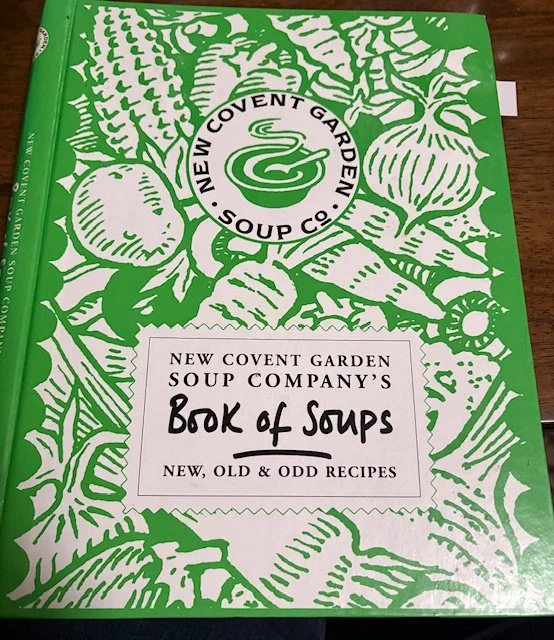
My husband Dylan and I first met in England in 1997. We were both volunteers with a program that placed young adults in their late teens through mid 20s for a year of volunteering with various churches and nonprofits, and we met as a pair of jet-lagged Americans at the international volunteers’ welcome conference. During our year there one of us—I’m pretty sure it was Dylan—either bought or was given New Covent Garden Soup Co.’s Book of Soups (1996). New Covent Garden made, and per Google apparently still makes, the sort of higher-end prepared soups that are sold in cartons rather than cans in grocery stores. And this cookbook is just what is says on the tin/carton: a collection of soup recipes.
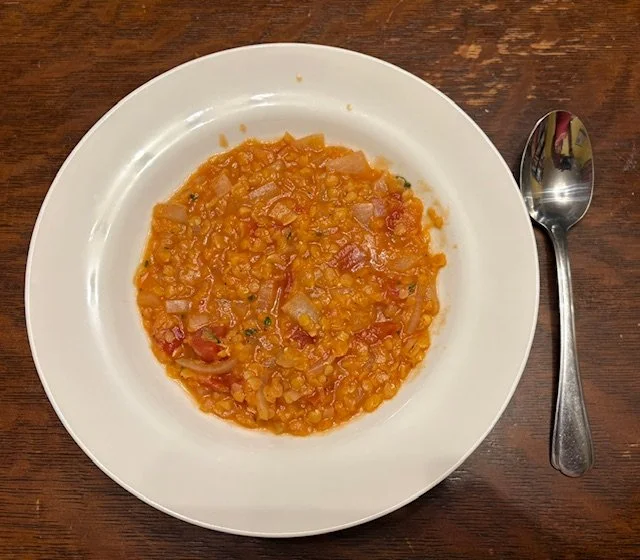
Because of this, I just made one recipe this week, since I couldn’t really do a main and a side or a main and dessert. (There are a couple of dessert soups, but most of them relied on currently out-of-season fruit like berries and melons.) I selected Lentil and Lemon Soup, because it was straightforward, quick, didn’t require much chopping, and made good use of our extensive stock of dried beans and canned tomatoes. It turned out simple and tasty, when paired with garlic bread a nourishing Sunday evening dinner on a cold night in a troubled world.
Lentil and Lemon Soup
2 T extra virgin olive oil
1 large onion, finely chopped
1 garlic clove, crushed (I used a teaspoon of jarred minced garlic—what a chef I follow on TikTok calls “jarlic”)
150g/5 oz red lentils, rinsed
570 ml/1 pint vegetable sotck
1 400g/14 oz tin chopped tomatoes (I used a 14.5 oz can diced)
2 tsp tomato puree (I wasn’t sure whether this was closer to tomato sauce or paste, but I went with paste because I figured it was a stronger flavor)
2 T finely chopped fresh thyme
salt and freshly ground black pepper
juice of 1/2 lemon, or to taste (ordinarily I’m a fresh lemon juice snob, but we have a bottle of lemon juice in the fridge from when Dylan was making quince jam this year, and I’m trying to be frugal so I used several generous splashes)
Heat the oil and cook the onion and garlic gently for 10 minutes without coloring. (Which I assumed meant at a low enough heat that the onions didn’t start to brown.) And the lentils and stir to coat well in the oil. Add the stock and bring to the boil. Add the tinned tomatoes, tomato puree, and 3/4 of the thyme. Bring back to the boil and simmer covered for 15-20 minutes, stirring occasionally. Taste for seasoning and add the remaining thyme. Add the lemon juice little by little to taste.
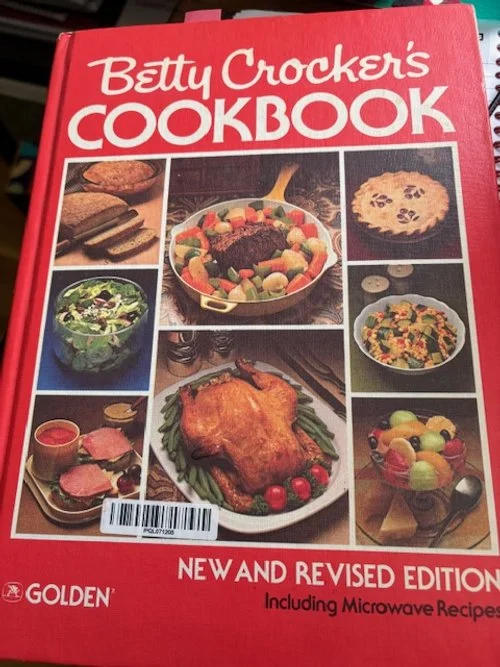
Cookbook Challenge # 3 - Betty Crocker’s Cookbook (1978)
Some of the cookbooks on The Shelf are family inheritances—including three separate editions of Betty Crocker’s Cookbook, all of which my husband and I claimed when clearing out his mother’s house after she passed away a few years ago. This is the newest of the bunch, with the other two copyrighted 1969 and 1950.
Of course, 1978 isn’t exactly recent (she says with a wince, given that she was alive and in elementary school at the time). This cookbook mostly features plain, hearty American fare, heavy on the roasts and casseroles. There’s barely any pasta to be found, and beef rather than chicken is the protein source featured most prominently. Really, it’s got me looking at the older cookbooks on my shelf with some trepidation.
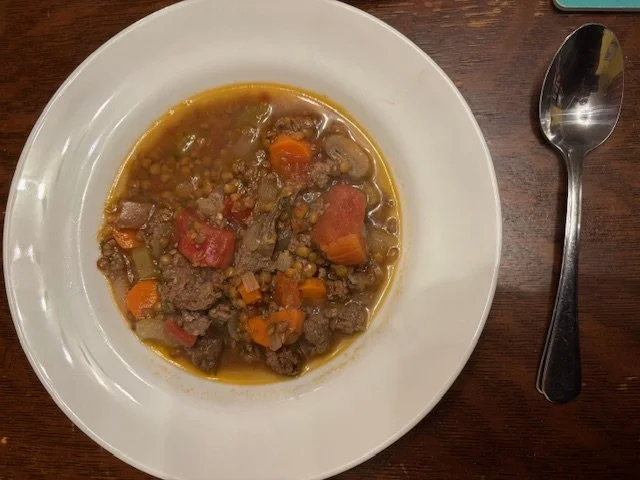
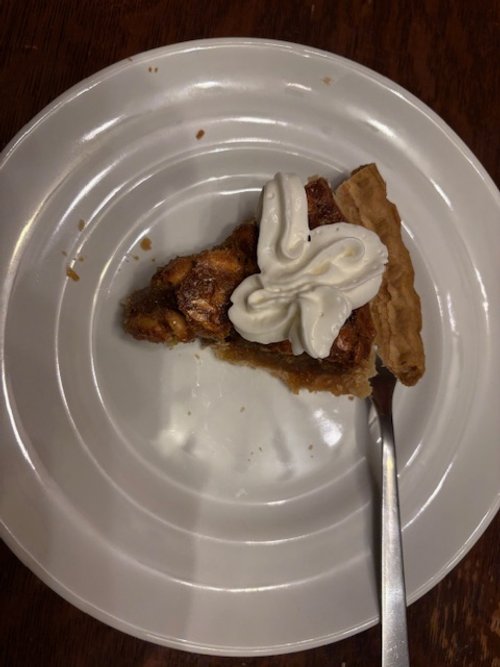
Since this doesn’t really reflect how we eat in this Year of Our Lord of 2026, it took me some time to settle on what to cook. I finally decided to focus on frugality, choosing recipes that would allow me to take advantage of ingredients already in my pantry or freezer—specifically half a bag of lentils, a pie crust, and a pound of ground beef. So last night’s dinner was Beef-Lentil Soup with a dessert of Southern Peanut Butter Pie. And they were…surprisingly good, as it turns out. The soup was plain and hearty in a good way, though I think if you left out the optional red wine it would be too bland. The pie was a bit one-note, sort of like if a peanut butter cookie or peanut brittle became a pie. If I make it again, I’ll throw in some chocolate chips or make a chocolate sauce to go with—sort of an homage to those “you got your chocolate in my peanut butter!” Reese’s commercials of roughly this cookbook’s vintage!
Beef-Lentil Soup
1 lb hamburger
1 med onion, chopped (about 1/2 cup)
1 clove garlic, finely chopped
1 4 oz can mushrooms stems and pieces (I’m sure fresh would also work, but I went with canned because authenticity and also it was cheaper)
1 16 oz can stewed tomatoes (I used 14.5 oz because I guess at some point the standard medium can size changed?)
1 med stalk celery, sliced (about 1/2 cup)
1 large carrot, sliced (about 3/4 cup)
6 oz dried lentils (about 1 cup)
3 cups water
1/4 cup red wine (optional)
1 bay leaf
2 T snipped parsley (I think snipped = fresh? That’s what I used, anyway)
2 tsp salt
1 tsp instant beef bouillon (I used Better Than Bouillon base, which I think is roughly the same thing, but I’m sure you could use a dried bouillon cube or just replace some or all of the water with beef broth)
1/4 tsp pepper
Cook and stir hamburger, onion, and garlic in Dutch oven until hamburger is light brown; drain. (Since hamburger runs leaner these days, I used a splash of canola oil and didn’t drain. I also went ahead and added the salt and pepper earlier than instructed.) Stir in mushrooms (with liquid) and remaining ingredients. Heat to boiling; reduce heat. Cover and simmer, stirring occasionally, until lentils are tender, about 40 minutes.
Southern Peanut Butter Pie
Pastry for a 9-inch one crust pie
2/3 cup sugar
1 tsp salt
1 cup dark corn syrup
1/3 cup creamy peanut butter
3 eggs
1 cup salted peanuts
Heat oven to 375. Beat sugar, salt, corn syrup, peanut butter, and eggs; stir in peanuts. Pour into pastry-lined pie plate.
Bake until crust is golden brown, 40 to 50 minutes. (Center of filling may be slightly soft but will become firm as pie cools.) Cool slightly; refrigerate. Serve with whipped cream or ice cream if desired.
Cookbook Challenge # 2 - The Best Recipes in the World
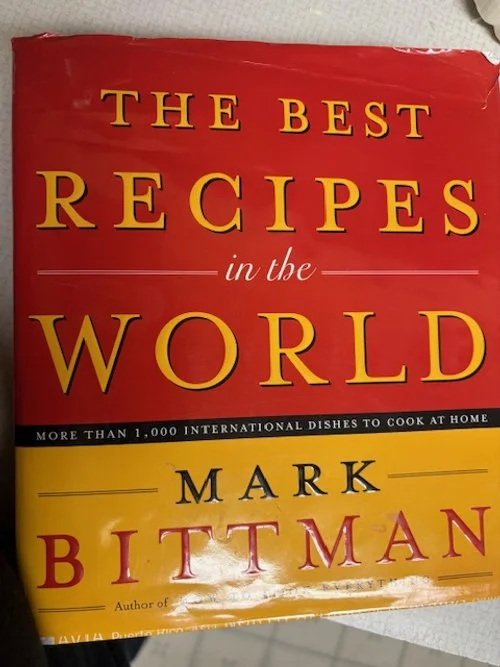
The second step on my long journey through my cookbook shelf was The Best Recipes in the World by Mark Bittman (2005). I have several Bittman books, since his recipes tend to be reliable and readily achievable by a reasonably experienced but not expert-level home cook. This is one of his more encyclopedic tomes, and as full of variety as the title suggests, though it skews heavily toward the well-known world cuisines. Lots of French, Italian, Japanese, Chinese, and Mexican, a good amount of Korean, Spanish, Indian, Caribbean, and Middle Eastern, and not so much of anything else. Personally, I’d love to find a cookbook like this, but focused on the hidden gems of lesser-known cuisines.
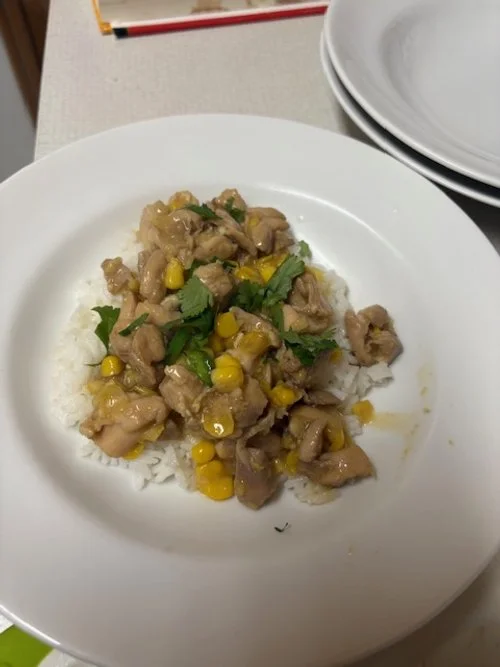
And originally I’d hoped to go as off the beaten path as I could. However, this was a long, stressful week, so I decided to go for something that was fairly straightforward and that used some of the boneless, skinless chicken thighs I stocked up on last time I was at Costco. I chose two Chinese recipes—Spicy Cold Celery (which I forgot to photograph) and Stir-Fried Chicken with Creamed Corn. The latter is a Hong Kong recipe that apparently reflects some of the East-West fusion of that city and allowed me to feel like I was being at least a tiny bit more adventurous than if I’d chosen, say, Kung Pao Chicken or Chicken Teriyaki.
Both recipes were pretty good. Spicy Cold Celery is similar to the kind of quick pickle or salad I often make with cucumber, and I can easily see myself making it again, though I might replace the sesame oil with more vinegar or lemon or lime juice. As for the chicken, it looked weirder than it tasted, and I liked it enough to save the leftovers for lunch. I agree with Bittman’s note: “It’s not fancy, but it’s a good home-cooked dish, quick, easy, and convenient.”
Spicy Cold Celery
1 pound celery stalks
1 tsp salt
1 Tbsp plus 1 tsp sugar
3 Tbsp dark sesame oil
1 Tbsp soy sauce
2 tsp vinegar, preferably rice or cider (I used rice)
1 garlic clove, minced
1 tsp chili oil, optional
Cut the celery into 2-inch lengths. Mix with the salt and 1 tsp sugar and set aside while you whisk together the remaining ingredients.
Rinse, drain, and pat dry the celery, then toss with the dressing. Let stand in the refrigerator for at least 3 hours and up to a day. Serve chilled. Serves 4.
Stir-Fried Chicken with Creamed Corn
1 pound boneless, skinless chicken breasts or thighs, cut into roughly 1-inch chunks.
2 Tbsp soy sauce
1 tsp dark sesame oil
1 Tbsp Shaoxing wine, dry sherry, or white wine (I used white wine)
2 Tbsp neutral oil
1 Tbsp minced garlic
1 Tbsp peeled and minced ginger
1 small fresh chile, stemmed, seeded, and minced, or hot red pepper flakes to taste (I used a jalapeno)
1 15 oz can creamed corn
1 cup fresh, frozen, or canned corn kernels (I used canned)
Chopped fresh cilantro leaves for garnish
In a small bowl, mix the chicken with the soy sauce, sesame oil, and wine. Marinate while you prepare the other ingredients.
Put the oil in a deep skillet or large wok, and turn the heat to high. Drain the chicken. When the oil is hot, add the chicken to the skillet and cook, undisturbed, until the bottom browns, about 2 minutes. Stir once or twice and cook for another 2 minutes. Turn the heat to medium-low.
Add the garlic, ginger, and chile and stir; 15 seconds later, add both types of corn. Cook, stirring occasionally, until heated through, 3-4 minutes. Garnish with cilantro and serve over rice.
Note: As I often find with Bittman’s recipes, this was a bit under-seasoned. Use a heavy hand with the cilantro, be prepared to add more soy sauce or salt, and have your hot sauce bottle handy.
Cookbook Challenge # 1 - Betty Crocker’s Old-Fashioned Desserts
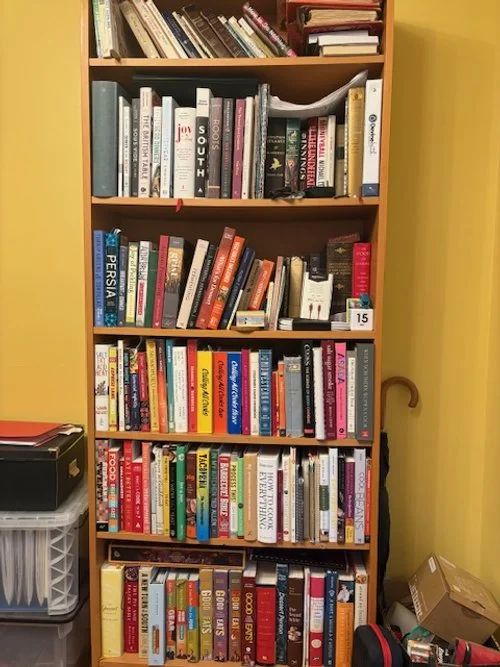
My husband and I have a lot of cookbooks. Like, they almost fill a full-sized Billy bookshelf. Sure, astute observers may notice that not every single book in that image is a cookbook, but they for sure predominate.
It’d be one thing if we consulted them on a daily or weekly basis as we plan our meals, but we don’t. I have favorite recipes in a few of them, easily identifiable by spill-stained pages, but usually if I want to cook something specific I’ll just google “vegetarian chili” or “recipes with boneless skinless chicken thighs” or whatever. And at a guess, I’d say I’ve never made anything at all from at least half of them.
I feel a bit guilty about that, but somehow the cookbooks always stay on the shelf whenever I’m having a downsizing fit. And I think Marie Kondo would approve, because having them there to look at, and occasionally pull off the shelf and page through, sparks joy.
So one of my resolutions for 2026 is to begin cooking my way through this bounty. In a fit of nerdy hyperfocus, I made a list of all the cookbooks and randomized it. For each book, I’m going to try to cook two recipes, at least one of which is new to me. While the goal is to do a cookbook per week, I know I’m going to miss weeks here and there between travel, holidays, and life and general. Which is fine by me—this is supposed to be a fun project, not a chore!
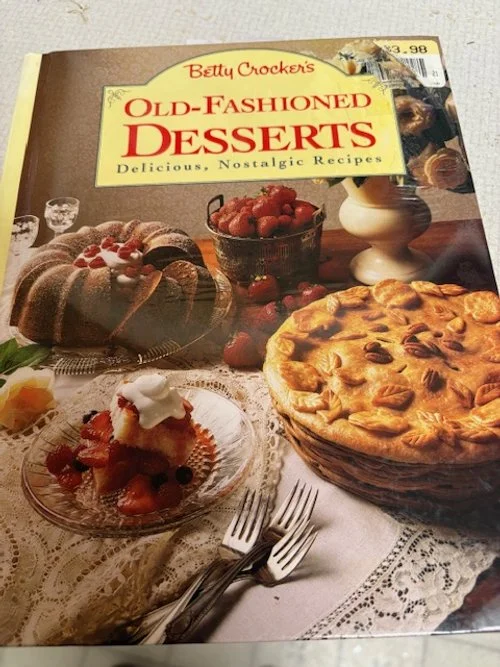
And the randomly selected first book is Betty Crocker’s Old-Fashioned Desserts (1992). I picked it up off the bargain counter at the Border’s in Center City Philadelphia in ‘93 or ‘94, and I’ve often paged through it lovingly, admiring the color photos and the sidebars on baking history…but somehow I’d never actually MADE any of it.
My two chosen recipes were Eggnog Pound Cake and Maple-baked Winter Pears, which I combined into a single plate and served as dessert tonight after a simple dinner of chicken caesar salad and garlic bread.
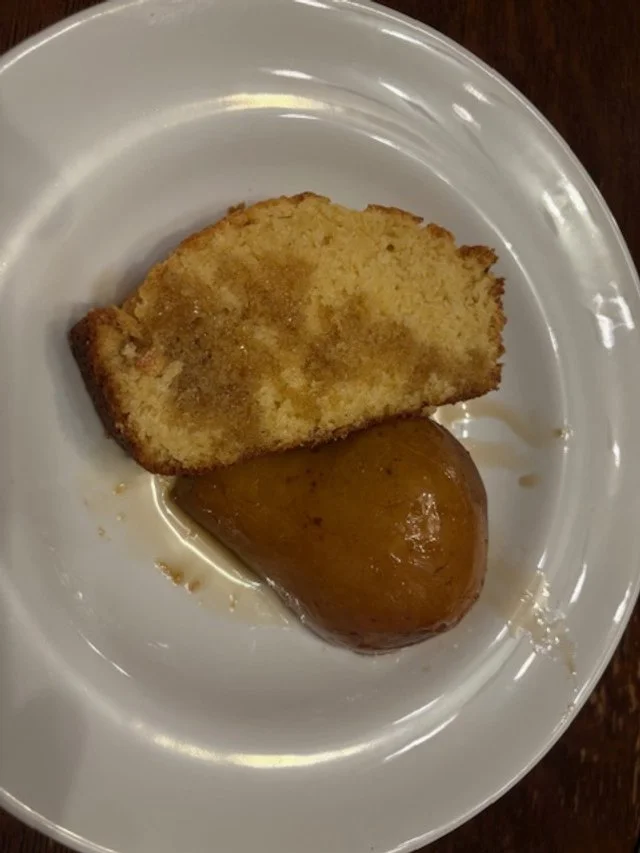
Both turned out…pretty good. Nothing spectacular, but sweet and soothing. Old-fashioned, you might say. I might make the pear recipe again, since it’s a super-simple way to make something of a treat out of a fruit I’ve never much cared for in its raw state. As for the cake, it’s way better than any grocery store pound cake, but it lacks the rich buttery density and moistness of my mom’s favorite recipe (which is in one of those cookbooks on the shelf, and I dearly hope I either remembered to mark it or one of my brothers or sisters-in-law did in their copies).
Maple-baked Winter Pears
6 pears, pared, cut in half and cored (I used half this amount but the full amount of the sauce ingredients)
1/2 c packed brown sugar
1/3 c maple sugar
1/4 c water
2 tsp grated lemon peel
1/8 tsp ground ginger
Heat oven to 350. Place pears, cut sides down, in ungreased rectangular pan, 13x9x2 inches. Mix remaining ingredients. Pour over pears. Bake uncovered, 20 to 25 minutes, brushing pears occasionally with syrup, until tender. Serve warm.
Eggnog Pound Cake
1 c sugar
1/2 c butter, softened
2 Tbsp rum
1 tsp vanilla
5 egg yolks
1 3/4 c all-purposed flour
2 tsp baking powder
3/4 tsp salt
1/2 tsp ground nutmeg
3/4 c milk
Heat oven to 350. Grease and flour loaf pan, 9x5x3 inches. Beat sugar, butter, rum, vanilla, and egg yolks in large bowl on low speed 30 seconds, scraping bowl constantly. Beat on high speed 5 minutes, scraping bowl occasionally. Beat in flour, baking powder, salt, and nutmeg alternately with milk on low speed. Pour into pan.
Bake 50-60 minutes or until toothpick inserted in center comes out clean. Cool 10 minutes; remove from pan and cool completely.
My 2025 reading
Going into 2026, I’m planning to do monthly updates on what I’m reading. But for now, here’s a list of the books I loved best out of the 150 I read this year, listed in the order I read them. (Yes, I really do read that much, though the count includes novellas and even novelettes.)
A Love Song for Ricki Wilde by Tia Williams. This is on the surface a paranormal romance, but a unique one, written from a semi-omniscient POV that's unusual in modern genre fiction but gives a certain mythical once-upon-a-time feel that really works for it.
How to Winter by Kari Leibowitz. A rare self-help book, in that I’ve actually been applying its lessons on how to thrive and find joy in wintertime as I go through what we in Seattle refer to as The Great Dark. Currently, 10 days or so after the solstice, the sun is rising around 8 AM and setting before 4:30 PM.
The Ministry of Time by Kaliane Bradley. This science fiction novel is the only case I know of where my fiction tastes have overlapped with Barack Obama’s—it made his Summer 2024 reading list. (In nonfiction we’re more alike.)
Someone You Can Build a Nest In by John Wiswell. Just your average horror-fantasy monster-slaying romance written from the perspective of the monster.
Who Is Government? ed. by Michael Lewis. A beautiful look at some of the extraordinary yet ordinary employees of the US government. Unfortunately it was also a depressing look, given the current state of things.
The Maid and the Crocodile by Jordan Ifueko. I really enjoyed this YA fantasy novel with an ordinary, humble heroine who (mostly) stays ordinary even as she comes into her voice and confidence.
The Scapegracers and its sequels by H.A. Clarke. What a fun, twisty, chaotic YA horror-fantasy!
The Adventure of the Demonic Ox by Lois McMaster Bujold. A lovely novella in the long-running Penric & Desdemona fantasy series, and an excuse for a comfort re-read of most of the earlier entries in the series.
Hemlock & Silver by T Kingfisher. While I will read Kingfisher's horror novels, I'm always happiest when she writes books like this, fantasy with a nice thread of romance and just a smidge of horror here and there.
The Wildings by Nilanjana Roy. A fantasy novel about a band of feral cats in Delhi--it reminded me of the Warrior Cats series my son loved as a child, only much more elegantly written and grounded in its setting.
The Grimoire Grammar School Parent Teacher Association by Caitlin Rozakis. A delightful and rather cozy fantasy about a mundane mother who has to try to make a place for her family in a snooty, competitive magical town after her daughter is bitten by a werewolf and can no longer attend a "normal" school.
Long Live Evil by Sarah Rees Brennan. A portal fantasy where a young woman on the verge of death from cancer is granted a chance to live in the world of a popular dark fantasy series, only to find herself playing the role of one of the main villains. It's dark, bloody, and often hilarious, and I've already preordered the sequel that's due out next spring.
You Should Be So Lucky by Cat Sebastian. An utterly heartwarming m/m baseball romance set in NYC in 1960.
A Declaration of the Rights of Magicians by H.G. Parry. What if the French and Haitian Revolutions, but with necromancers, vampires, weather mages, and the like, many of whom will be very familiar from the pages of your history books or your hours spent listening to Mike Duncan’s podcasts?
A blog? In THIS economy?!
I realized recently that I really miss blogging—having a public journal where I can talk about topics that interest me (and hopefully other people!) at greater length than I can on BlueSky or similar sites. I considered vlogging, since I certainly enjoy watching other people’s YouTube and TikTok videos. However, I don’t really want to learn video editing or to have to worry about the best lighting and most flattering camera angles just to be able to talk about what books I’ve read lately or the really cool bird I saw at the arboretum…so blogging it is, even if that makes me something of a (non-avian and therefore extinct) dinosaur.